Photography and geology share a strange quality. Both capture what has been. A rock bears within it the layers of millions of years, each layer a silent record of pressure, heat, and movement. A photograph does something similar. It freezes a moment, makes it permanent, saves it from oblivion. And yet both lie in their own way. The rock conceals what happened between the layers. The photograph chooses what to show—and what not to. It is precisely within this tension between preservation and distortion, between archive and interpretation, that Ways of Fixing Time, the quietly powerful installation by Madrid artist Clara Carvajal currently on view at Casal Solleric in Palma, operates. The exhibition runs until May 24, 2026. And if you haven’t been yet, it’s worth going soon.

The Memory of a Coastline
The show is installed in the Aljub, the vaulted underground cistern of Casal Solleric. It is, as it turns out, the perfect setting. The ancient space pulls you downward and inward. The right direction for an exhibition about depth, time, and things that endure.
Carvajal’s starting point was the archive of Casa Planas, one of the most remarkable photographic collections in Europe. The archive particularly holds images taken by Josep Planas i Montanyà, the Catalan photographer who moved to Mallorca in 1945 and spent decades shaping the visual identity of the island as a tourist destination.

His postcards and color prints created the dream of Mallorca — turquoise water, white sand, an eternal summer. They also documented, often inadvertently, the dramatic transformation of the island’s coastline.
That transformation is what Clara Carvajal focuses on. Specifically, she zeros in on the northern coast of Mallorca and the way tourism altered its geology, its look, and its meaning.

When Tourism Reshapes a Landscape
It sounds abstract. But the work makes it tangible. Clara Carvajal draws a line between the physical material of the coast — the rock, the stone, the geological strata — and the photographic record of how that coast was seen, sold, and consumed.
Stone, in this reading, is already a kind of archive. It records time in its layers. Meanwhile, photography does something similar. Both fix a moment. Both make it permanent. And yet both are also subject to interpretation, to framing, to the stories we choose to tell about them.
That parallel is what gives the show its intellectual tension. Moreover, it gives it its emotional weight. Because the story Carvajal tells is not a simple one. The tourism boom that brought prosperity to the Balearic Islands also, in various ways, consumed the very landscape it was selling. The rocks and coves that looked so pure and timeless in those postcards were, even then, undergoing irreversible change.

Clara Carvajal and the Biology of the Image
Carvajal was born in Madrid in 1970. She studied Fine Arts at the Complutense University and later at the Blake and Heatherley School of Art in London. Over the years, she has developed a practice that moves freely between sculpture, photography, printmaking, and installation. What unifies her work is an interest in how images transform as they travel through different materials and media. She has called this the “biology of the image.”
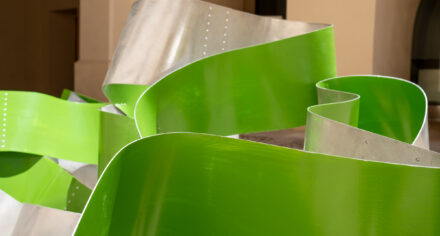
Here in Palma, she applies that same logic to the Casa Planas archive. She does not simply reproduce or display the historical photographs. Instead, she translates them. She moves between image and object, between the two-dimensional surface of a photograph and the three-dimensional reality of a stone. In doing so, she creates something genuinely new.

An Archive That Keeps Growing
For those not yet familiar with Casa Planas, it’s worth a detour. The foundation, located in the Es Fortí neighborhood of Palma, is run by Marina Planas, granddaughter of Josep. Since taking over in 2015, she has transformed it from a private archive into a living center for contemporary art and research.
The collection contains more than three million photographs and negatives, as well as 18,000 postcards. It is, in effect, the largest photographic archive of mass tourism in the world. Artists in residence work with the material on an ongoing basis. And increasingly, those collaborations are making their way into public exhibitions.

Ways of Fixing Time is one of the most significant results of that program to date. It also marks the first time the archive has served as the backbone of a major institutional show at Casal Solleric.

The Aljub as a Stage
Back in the space itself, the installation has an atmosphere that is hard to shake. The vaulted ceiling of the Aljub presses down. The light is deliberate and spare and the works are positioned in ways that reward slow looking.
Additionally, there is something fitting about showing work about geological time in a cistern. The Aljub is itself a structure built to hold and preserve.

The exhibition Formas de Fijar el Tiempo (Ways of Fixing Time) is on view until May 24, 2026. Admission is free. A closing event, Ecos i Veus de Pedra (Echoes and Voices of Stone), takes place at Casal Solleric on May 22 at 7pm. It combines a guided visit with a dramatized reading. The event is also free and open to the public. 
Read more about Casa Planas, here.
Casal Solleric
Passeig del Born, 27
07012 Palma de Mallorca